April 6, 2026
By Sam Weiger
The 2025 season provided a fascinating blueprint for the future, offering a mix of breakout stars, shifts in player roles, and noteworthy team-wide changes. As we look ahead to 2026, many of these storylines aren't just isolated incidents, they are building momentum. Here are some key UFA trends from last season that could continue this season.
Paul Krenik’s shift to defense
After a mid-season shift from O-line to D-line in 2025, Paul Krenik became a permanent fixture on the D-line. Krenik was incredibly disruptive, using his elite anticipation to transform Minnesota’s D-line defense. Last August against Atlanta, he put together one of the most dominant defensive showings in Championship Weekend history.
Krenik finished with five blocks against the Hustle—the highest single-game total of the postseason. This defensive role is familiar territory for Krenik, who played primarily on defense throughout 2023 and 2024. While the Wind Chill have five projected defensive starters in Noah Hanson, Justin Burnett, Dylan DeClerck, Cameron Lacy, and Blake Krapfl, the remaining spots on the line are expected to be a revolving door of high-level specialists.
Krenik fits perfectly into this hybrid rotation alongside other versatile threats like Noah Coolman and Lukas Ambrose. Although he is coming off a career-best year offensively—and despite the O-line being the team’s primary area of concern—the addition of two-way talents like Coolman and Nate de Morgan gives Feldman more flexibility with how he deploys Krenik. Expect Krenik to spend plenty of minutes on both units, possibly leaning more heavily into the defensive role.
Gaudy stat lines from Mark Henke and Jackson Potts
Mark Henke and Jackson Potts didn't just meet expectations last year, they shattered them. Both players successfully transitioned from reliable depth pieces into elite, top-tier playmakers. Given their upward trajectories and a favorable 2026 schedule, the duo is primed to continue their explosive production for the Sol.
The Austin Sol benefit from the easiest strength-of-schedule among playoff contenders. Their schedule features six matchups against Vegas and Houston—the two lowest-ranked teams in the preseason power rankings.
The Bighorns’ defense surrendered an average of 24.92 goals per game, the second-worst mark in the league, so both Henke and Potts have the potential to feast on Vegas.
Both players already proved they can dominate Houston last year. In Week 11, Henke racked up eight assists, four goals, and 500+ receiving yards. In Week 3, Potts finished with nine total scores and nearly 500 total yards.
While the soft schedule helped, labeling their 2025 breakouts as flukes would be a mistake. Their dominance, which they also put on display against playoff teams, was the result of consistent year-over-year improvement.
Both set career highs across major categories (assists, goals, and yards) in 2024. The departures of Evan Swiatek, Mark Evans, and Duncan Fitzgerald in 2025 opened the door for them to make their breakthrough.
Even with the return of Swiatek, there is more than enough volume to go around. Expect Henke and Potts to maintain their status as statistical heavyweights as they look to lead the Sol back to the postseason.
DC’s offensive decline
For the first time since 2013, the DC Breeze saw their scoring average dip below 20 goals per game in 2025. Averaging a lackluster 18.14 goals, they ranked as the lowest-scoring playoff team and seventh-worst in the UFA. This decline was punctuated by a dismal nine-goal performance in their East Division title game blowout against Boston.
Heading into 2026, there is a legitimate concern that the offense will continue to stall. The roster has been hit by a significant talent drain, as franchise icons Rowan McDonnell and Tyler Monroe are stepping away. While the additions of Sean Mott and Wiebe van den Brink bring skill to the table, they face the monumental task of replacing the production and leadership of those departing stars.
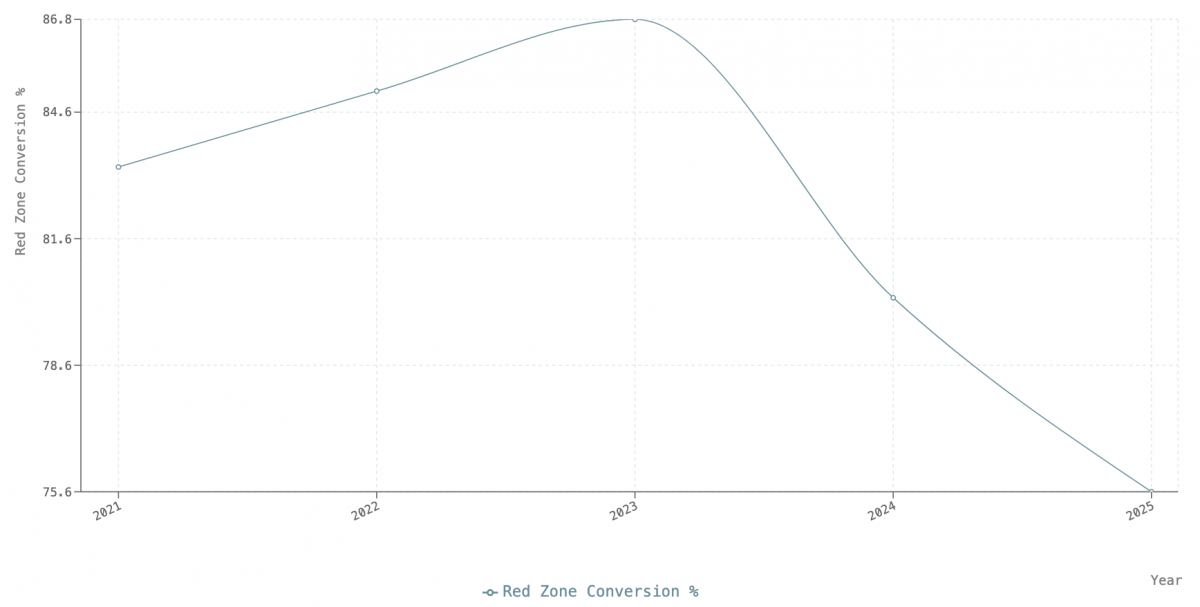
The loss of Jonny Malks after 2024 already proved how fragile the Breeze's offensive rhythm could be after losing an offensive fulcrum piece; losing McDonnell and Monroe further strips the unit of its core identity. Navigating this transition falls on first-year Head Coach Xavier Maxstadt, who must implement a new system quickly in a highly competitive East Division.
Compounding these growing pains is a brutal 2026 schedule. DC is set to face a gauntlet of tricky defenses, including two matchups against New York and Boston, and interdivisional tests against Atlanta, Carolina, and Colorado.
Seattle being a dangerous team
Low expectations followed Seattle throughout 2025, and the narrative hasn't shifted much heading into 2026. However, the "overlooked" label is exactly what makes them dangerous. While they didn't notch wins against West Division heavyweights Salt Lake or Oakland last year, they pushed both to the brink, losing by a single goal in "photo finish” thrillers.
The engine in these close games remains the elite duo of Garrett Martin and Zeppelin Raunig. As one of the UFA’s most reliable offensive tandems, their ability to take over games keeps Seattle within striking distance of anyone. Supplementing them are rising stars Conor Belfield, a vital dual-threat, Langley Fitzpatrick, the team’s reigning block leader, as well as the sneakily effective Derek Mourad, who completed the most hucks in the UFA last season without a throwaway (12).
Their X-factor for 2026, however, lies in the return of dormant talent. Spencer Lofink, a premier playmaker who was limited to just one game last year, provides the handler playmaking that Seattle lacked in 2025. Additionally, the return of Kodi Smart, who last suited up in 2019, adds another talented handler back to the rotation. Despite the hiatus, Smart is only 26, and if he nears his 2018 form (39 assists, 23 goals, 503 completions), Seattle won't just be pushing heavyweights to the wire—they’ll be beating them.
Jack Williams’ role change
Jack Williams struggled with a hamstring injury in 2025, and his production took a visible hit, with goals and receiving yardage dropping significantly from his 2024 campaign. While suggesting his receiving stats might stay low is a hot take, it’s a scenario that could realistically happen and actually benefit the Empire.
The Empire’s offensive landscape will very likely shift this year. With Daan de Marrée established as the centerpiece of the O-line and Matt LaBar poised to build on his 2025 breakout as a receiver, Williams is no longer required to be the high-volume receiver he was in 2024.
Williams transitioned into a primary facilitator last season. He saw an increase in his throwing yards and completions. Whether this shift was a byproduct of limited mobility due to injury or a tactical choice, it is a strategic way to keep him fresh.
For Head Coach Anthony Nuñez, the 2026 priority could likely be keeping Williams healthy for the playoffs. Williams is historically one of the greatest playoff performers in franchise history, so Nuñez might let younger stars like De Marrée and LaBar shoulder the receiving load in the regular season alongside Ben Jagt.
Oakland failing to close out games
Despite a roster overflowing with talent, Oakland repeatedly struggled when the stakes were highest last season. Pinpointing a single reason for their struggles is tough, but the primary culprit was a lack of preparedness for those pressure-filled moments.
History suggests Oakland’s unpreparedness could become a trend; franchises like Atlanta and DC have spent years trapped in similar cycles of big-game frustration, so Spiders fans should be legitimately concerned that their team might be headed down that same path.
Oakland’s O-line, which anchored the team’s most successful regular season since 2015, faltered when the pressure was highest during their West Division Championship loss to Salt Lake. Key offensive facilitators like Evan Magsig and Jason Vallee made errant throws, and scorers like Walker Frankenberg and Saul Wildavsky were uncharacteristically quiet.
The O-line’s lack of poise was a three-fold issue: veteran underperformance in high-stakes moments, coaching lapses, and a general lack of experience elsewhere on the unit.
The Spiders' late-game collapse against Salt Lake exposed their scariest vulnerability: the struggles of veteran leaders Magsig and Vallee. As the team's primary facilitators, their lack of composure is a major cause for concern.
This lack of direction ultimately reflects on the coaching staff. New head coach Liam Kreiss, while a fresh face, faces a steep learning curve. At just 28 and with zero prior experience as a UFA head coach, there are legitimate doubts about whether Kreiss can get his team to Championship Weekend this year.
Furthermore, the roster's youth adds another layer of doubt. Key players Leo Gordon, Adam Rees, and Wildavsky are entering only their second professional season, and Raekwon Adkins is still developing as a college student.
Kainoa Chun-Moy’s shift to offense
Madison has made the playoffs in each of the last two seasons, but maintaining that streak looks difficult following Indianapolis’s aggressive offseason moves. With the offense remaining the Radicals' primary weakness, the team needs 2025’s breakout performers to deliver once again—especially Noa Chun-Moy.
Last season, Chun-Moy transitioned from D-line to O-line, resulting in the most productive offensive campaign of his career. He set personal bests across every offensive statistical category and led the team with 36 assists. Chun-Moy and fellow Radicals newcomer Eric Sjostrom combined to give Madison their most stable backfield throwing battery in years.
And while the return of franchise throwing yardage leader Victor Luo provides a veteran option, Madison still needs a dual-threat O-liner like Chun-Moy to make the offense less predictable. He was the only Radical last year to record at least 15 goals and 15 assists, proving his value as both a facilitator and a finisher.
Unlike some teammates whose production dips against top-tier competition, Chun-Moy has shown no such trend.
In fact, he has a proven track record of performing against the stiffest competition. In 2025, his standout performance came against Chicago, where he racked up four assists and 523 total yards. This trend dates back to his 2023 tenure with the Phoenix, where two of his best outings came against elite squads like Carolina and New York.
Madison struggled significantly against winning teams last year, finishing with an 0-5 record in those matchups. If the Radicals hope to reverse that trend and navigate a tougher divisional landscape, Chun-Moy’s ability to rise to the occasion will be needed on the O-line.
Atlanta staying huck-happy in the playoffs
Last year, the Atlanta Hustle finally silenced their critics by securing a spot at Championship Weekend, fueled by a newfound commitment to a more aggressive approach.
After averaging a conservative eight huck attempts during their 2023 and 2024 playoff exits, the Hustle upped the ante in 2025, averaging 13 attempts per game with a solid 64.5 percent completion rate.
Leading the charge was Austin Taylor, who fired six hucks over two games at an elite 87.5 percent clip. This statistical jump was no accident; while Taylor has had talent like Brett Hulsmeyer and Hayden Austin-Knab at his disposal for several years, the 2025 roster additions of Alec Wilson Holliday and Cam Brock created a defensive headache.
Even with Brock’s departure, the arrival of Will Selfridge ensures Taylor still commands a premier receiving corps, so Atlanta has the weapons to remain aggressive with the long ball this postseason.