March 3, 2026
By Charlie Hoppes
Charlie Hoppes is currently a coaching consultant for the Indianapolis AlleyCats in 2026, and is formerly a two-time UFA champion head coach with the New York Empire.
In ultimate frisbee, offense is king. Scoring is so expected, especially at the highest levels, that we’ve long used language from tennis to describe the action–score when you start with the disc and it’s a “hold,” while a goal after starting on defense is a “break.” Having a solid offense is just about a sure ticket to the playoffs. Since the current 12-team playoff format launched in 2022, the top ten best-holding offenses each season have made the playoffs a whopping 90 percent of the time. The only top five offense to miss the playoffs were last year’s slow starting Carolina Flyers, who dropped their first four games of the season before going 7-1 down the stretch of their schedule.
Statistically and historically, the greatest sign of success in the UFA is hold percentage.
Then why is it that, over the last three years, a rare absolute in an ever-evolving league was that the Minnesota Wind Chill would be at Championship Weekend? The only other team to appear even twice at Championship Weekends in that stretch has been the Salt Lake Shred. The seven other teams could make that final championship push just once each since 2023.
The numbers tell us this shouldn’t work. Here are the 12 participants in those weekends, listed with their rank in the league that season in hold percentage:
| Division | 2023 | 2024 | 2025 |
| East | New York - 3rd | DC - 2nd | Boston - 5th |
| Central | Minnesota - 12th | Minnesota - 7th | Minnesota - 15th |
| South | Austin - 17th | Carolina - 3rd | Atlanta - 1st |
| West | Salt Lake - 2nd | Seattle - 14th | Salt Lake - 3rd |
We do have other outliers here. The 2023 Austin Sol and the 2024 Seattle Cascades are the only two teams with weaker offensive showings than the Wind Chill’s best offense through these years. Both arrived at Championship Weekend on the backs of massive upsets in legendary games, and both were quickly dispatched in the semi-finals.
The Wind Chill, on the other hand, never play as though they are just happy to be there. In 2023, it took the single most clutch play in history of the league–Joel Clutton’s buzzer-beating tip to Elijah Jaime–followed by a blown lead in overtime, to keep them from the championship game. In 2024, they were far and away the best and most confident team handling windy conditions in Salt Lake, beating two excellent teams on their way to a title. And to shut up the last of the haters, they knocked off one heavy title favorite in the Chicago Union to make Championship Weekend, then another when they pushed past the Atlanta Hustle in the semi-finals, before falling in a tight championship game to a surging Boston Glory.
The 12th, seventh, and 15th best offenses in the league should not be within shouting distance of a championship game, never mind being the only team that you could count on in the league to get to the dance three straight seasons. How, exactly, are they doing this?
You may have guessed the short answer–the Wind Chill have had the best defense across those three seasons collectively. If hold percentage is the best statistical indicator of a playoff team, let’s assume break percentage is our best look at an elite defensive impact. In both 2023 and 2024, Minnesota had the third best break percentage in the league. In 2025, they upped that to the second best break percentage in league history, only behind the powerhouse Union team they suffocated in the Central Division final. No other team has three top-five appearances on that leaderboard in that time.
So the signings this off-season may have come as a bit of a surprise, as the Wind Chill went out and got two of the best defenders in the sport, signing 2024 Defensive Player of the Year Lukas Ambrose and the 2025 league leader in blocks, Noah Coolman. They also picked up Nathan De Morgan, named Ultiworld’s college rookie of the year in 2025–a supremely talented player, known in part for his aggressive throwing game. Even with a historically strong defensive line, adding Ambrose and Coolman would mark an enormous upgrade.
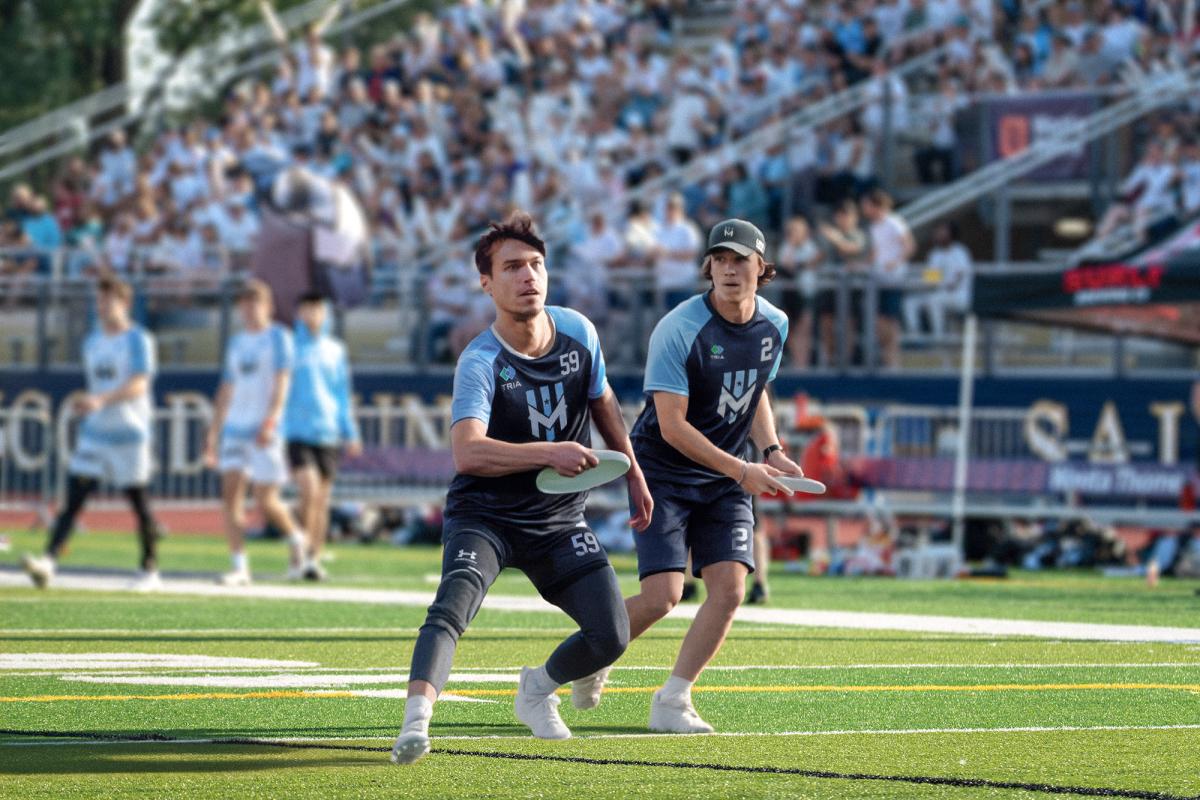
Ben Feldman has proven to be one of the most creative coaches in the league, and is arguably the best at in-game management as well. Adding some new levers for Feldman to pull is an exciting proposition for Wind Chill fans.
One of the hallmarks of the Minnesota defense last year was a handler defense that spent a lot of time in the lanes. For much of each game, the only time the Wind Chill would play tighter on a handler was if their positioning also allowed them to bother the throwing lane as well. This allowed the defense to set double-teams opportunistically, and startle throwers with windows that would shrink unexpectedly. The quickness of these defenders prevented opponents from swinging the disc quickly enough to exploit the lane poach, creating a feeling of always looking into the teeth of the defense on every touch. They coupled this with extremely athletic, block-hunting defenders downfield. The handler defenders would provide plenty of easy completions to other members of the backfield for opposing O-lines (Wind Chill opponents completed 276.4 passes a game, good for third in the league, and entirely according to plan for the defense), but almost none of which would lead to the initiation of offensive flow. And if the offense wanted to attack downfield, these handler defenders would create throwing lanes that forced throws to loop, or be thrown behind, and the monsters downfield would feast.
The thought of Ambrose in this set up is tantalizing. His closing speed and ability to get blocks at angles that aren’t available to most players, coupled with a defense that would give him opportunities to showcase those traits nearly every possession, is a hard thing to pass up.
Coolman, after starting last season on the Summit O-line following a full season there in 2024, moved back to defense to great effect. Coolman excels in his versatility. Need to shut down a handler or initiator? He’s as quick as they come, and hard to move once he’s established position. A disc floating downfield? Coolman can make highlight reel bids and skies with the best of them.
Considering the need to increase hold percentage, however, it’s hard to imagine the duo will slot onto D-line without real shuffling. After all, a hold doesn’t need to mean that the offense scores on their first try. Coolman had a strong season on the Colorado O-line in 2024, and having an offensive playmaker and defensive block-getter of his magnitude on an offense that turns the disc over far more than other championship hopefuls could add significantly to that line on both sides of the disc. And while Ambrose has yet to see significant time on offense in the UFA, there is no question that there is plenty of talent on the offensive side for him as well. An O-line that is more tolerant of turnovers might be the best place for Ambrose to settle into a new role, and push his star to greater heights.
However Feldman and the Minnesota coaching staff play this, the league’s only defensive-centric title contender has been elevated to the league’s only defensive-centric title favorite. And with these additions, it’s very possible a top offense exists on the deeply talented roster as it stands. If the pieces fit together just right and the offense approaches the consistent power of their D-line, the 2026 Wind Chill stand to be the best Minnesota team yet.