September 8, 2026
By Sam Weiger
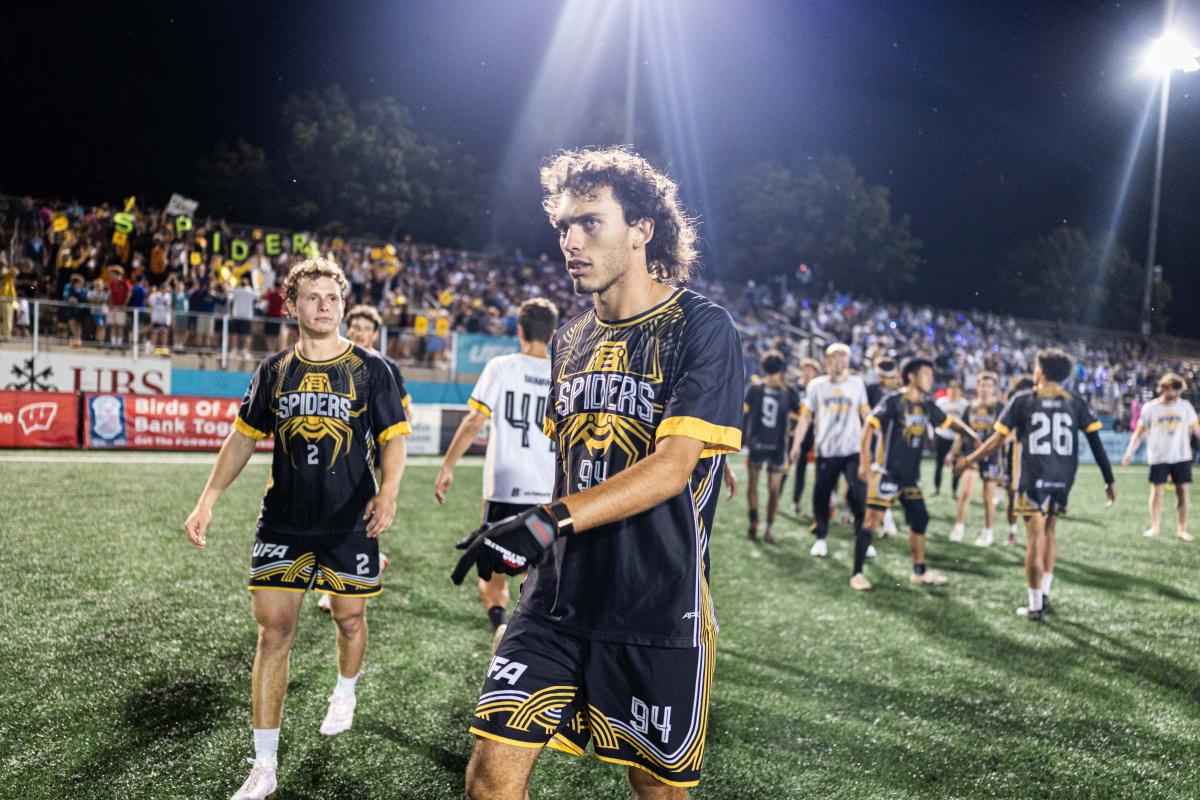
Oakland’s march to their third championship in franchise history was truly remarkable. From their effectiveness on both sides of the field to the evenly-spread playmaking, the Spiders’ numbers reveal that they may have just reshaped the UFA, establishing the template for future success in the league.
POSSESSION KINGS
Oakland’s capacity to stop break opportunities was an overlooked element of their game. We really witnessed it on display at Championship Weekend, when they contained New York and Minnesota, limiting these two elite offenses to converting just three combined breaks. Three!
That worked out to an opponent break percentage of 7.5 percent in Madison, a figure that was highly reflective of their ability to keep opponent break percentages low this year. The Spiders allowed an opponent break percentage of 13.04 percent this season, the second lowest opponent break percentage by any team since the statistic was first recorded in 2014.
What’s more? They allowed a break rate of 20 percent or higher in just one game against playoff-caliber opponents all year. They limited Minnesota to a 15 percent rate in Week 8, limited Salt Lake to rates of 17, 14, and 12 percent in their three convincing wins over the Shred, limited Seattle to a rate of 17 percent, and limited the Growlers to a rate of 11 percent in two meetings.
What also gets overlooked is how versatile each of Oakland’s players are, and this could be something that really matters for teams moving forward. Not only having deep rosters, but many adaptable players on both lines. O-line playmakers like Walker Frankenberg, Adam Rees, Jason Vallee, Daniel Ritthaler, and Stefan McCall were some of the players who were called upon to step up and defend opponent break chances, and they delivered big time.
MISTAKE FREE
While their remarkably impressive completion rate of 97.5 percent at Championship Weekend didn’t go unnoticed, it might not be known to many that the mark was historic.
It was the highest completion percentage by a team at the event since game stats were first tracked in 2014. Not surprising from a squad like Oakland, who had been completing passes at a high clip all year, but they reached their highest level of efficiency in Madison.
Sure, they got some help from very favorable weather conditions, but we can’t forget that they faced two very disruptive defenses in Minnesota and New York. To complete 97.5 percent of passes against those two teams on back-to-back days, that should not be overlooked.
So what elevated the Spiders to new heights at Championship Weekend? I think it all traces to two things: super coaching by Liam Kreiss and this team being as close to full strength as possible.
Kreiss excelled at boosting the team’s speed and output by tweaking lineups and inspiring everyone to win for their vets. This stat idealizes how Kreiss extracted top performance from the Spiders. Yet it’s taken time to build this momentum. Their regular season and playoff metrics have steadily climbed since their initial 2024 postseason run, with playoff figures surging highest. In 2024, they connected on 91 percent of passes during their sole playoff match. Last year, they hit 94 percent across two matches. And this year, they connected on 96 percent or more in three postseason matches.
Kreiss excelled at boosting the team’s speed and output with little things like tweaking lineups and inspiring everyone to win for their veterans. This number idealizes how Kreiss extracted top performance from the Spiders, but it’s taken time to build this momentum. Their regular season and playoff metrics have steadily climbed since their initial 2024 postseason run, with playoff figures surging highest. In 2024, they connected on 91 percent of passes during their only playoff game. Last year, they hit 94 percent across two games. And this year, they connected on 96 percent or more in all three postseason games.
Players such as Ritthaler, McCall, and Clyburn, who cycled in and out of the lineup all year and in prior seasons, came up with standout grabs to extend possessions. Others like Raekwon Adkins, Dillon Whited, and Robin Vickers Batzdorf gave opponents additional handlers and cutters to worry about, while players such as Frankenberg and Leo Gordon sharpened their efficiency.
SPREAD ATTACK
One clear sign of Kreiss's impact was his knack for keeping things balanced, reflected in the fact that not a single Spiders player cracked the top 15 in total scores this year. The only other UFA champion to not have a player in the top 15 was Minnesota in 2024.
Even though Minnesota won the UFA title without a top-15 scorer, I still wasn't convinced a team could win in today's league with just balance and no top scorers. The heavy winds in Salt Lake really altered the dynamic of that year's Championship Weekend, favoring the Wind Chill because of their familiarity with heavy winds and their ability to win on defensive plays rather than efficient offensive playmaking. So when the Chill won, roster depth and versatility weren't clearly the main reason for the title.
And even though the Chill won it all, their wins weren't especially convincing. Sure, they handled DC, but they barely escaped the Flyers in the final. So even setting wind aside, only managing to scrape by a Carolina team with two top scorers in Allan Laviolette and Anders Juengst didn't prove much about a deep team without a superstar being a clear formula for future success in the league.
Oakland's win hit different. There were no weather conditions or other potential asterisks surrounding their championship run. On top of that, they dominated all three of their playoff opponents. For these reasons, this is the number that proves depth and versatility without superstars is a viable future template for success in the UFA.
Yes, Frankenberg and Ritthaler played like league superstars at times this year, but I genuinely believe the team's depth and versatility mattered far more than those two players alone. The West Division title game was a perfect illustration of that, as the Spiders cruised past Salt Lake without either of them.
THE NEXT GENERATION IS NOW
What's genuinely striking about this Spiders squad is that among the numerous Spiders players who truly impacted Championship Weekend, only one active player had previously reached the final four, Jason Vallee.
The youth and lack of experience that some, myself included, viewed as a potential weakness proved completely irrelevant in Madison. Deep playoff experience has historically been crucial for recent champions. Both Minnesota and New York entered their title runs with substantial Championship Weekend experience, yet the previous two champions had barely any. Looking ahead, then, will that gap in postseason experience actually matter?
We can push Oakland's youth angle even further. Whereas the majority of Boston's key players entered Championship Weekend with at least four seasons in the UFA, many Spiders standouts had far less under their belts. Chander Boyd-Fliegel and Orme were first-year players, while Dexter Clyburn, Whited, McCall, Gordon, Rees, and Carter Lankford had only one prior season of experience.
And when comparing average age across these two most recent champions, the gap is substantial. In contrast to the Glory, several Oakland players are fresh out of or still in college, among them Boyd-Fliegel, Orme, Clyburn, McCall, Gordon, and Lankford.
Watching a young and untested roster steamroll two battle-tested teams at Championship Weekend is nothing short of historic, a genuine jolt to the entire league.
CLUTCH WHEN IT COUNTS
Oakland silenced critics who doubted them over red zone issues by posting an 86 percent red zone conversion rate in the playoffs.
Their biggest concern coming off last year’s quarterfinal exit was red zone efficiency; the Spiders finished with a 52 percent conversion rate against Salt Lake that year, their lowest single-game rate since the stat was first tracked in 2021.
Despite a strong rate for most of the regular season, the concern resurfaced when the Spiders struggled again late in the year. They converted just 73.5 percent of their red zone chances in two games against the Shred in the back half of the season, including a season-low 68 percent conversion rate in Week 10.
The influx of new faces on the attack brought that number back up. Ritthaler’s return made a huge difference, the emergence of Boyd-Fliegel over the course of the season gave the Spiders another key facilitator, and McCall, Adkins, and Whited added three elusive receivers who gave their postseason opponents fits.
But we can’t overlook the fact that some of these players simply raised their game in the red zone, most notably Frankenberg and Gordon. They had been quieter as scorers than in previous years heading into the playoffs, finishing the regular season with 45 and 33 scores, respectively. It was also noticeable that Gordon committed more errors than in 2025 in the red zone, with some of those issues reflected in his 24-turnover season.
Frankenberg silenced any doubts by racking up 15 total scores at Championship Weekend alone (missing the quarterfinal), while Gordon committed just three total turnovers on 92 postseason completions, the second-most throws of any Spider in the playoffs.
SMALLBALL SUCCESS
A second blueprint for future success, and one that's drawn more attention in recent seasons, is simply hucking less. Oakland averaged just 6.33 hucks per game, making it three consecutive champions now to finish below seven hucks per game.
That each of these championship teams had no shortage of capable deep throwers and receivers says a lot about where the league might be trending on deep shots. Oakland embodied this shift perfectly, fewer and fewer handlers are firing deep purely because a receiver has talent. Instead, the Spiders reserved their hucks for genuinely good looks with a receiver wide open or with a clear step on their defender.
That selectivity, that discipline about when to pull the trigger deep, may well be where the league is heading. Certainly, some connections are special enough to bend the rule—Laviolette to Jacob Fairfax, Alex Atkins to Daan De Marrée—but teams without those kinds of superstar pairings are often launching prayers unless they stay calculated and disciplined about their deep looks.
Oakland does have quality huck throwers in Evan Magsig, Boyd-Fliegel, and Ritthaler, and quality huck receivers in Adkins, McCall, Frankenberg, and Gordon. None of them, though, are truly elite in the deep game. The Spiders' ability to recognize that and adjust accordingly was a critical piece of their success, an adjustment some teams, like Indianapolis with its 56.64 percent huck rate, failed to make.
ELITE ON BOTH SIDES OF THE DISC
No team in the league accomplished what the Spiders did this season: finishing in the top two in both offensive and defensive efficiency. Oakland is the first team to pull off that dual top-two finish since the Empire did it back in 2022, and it's worth reflecting on just how difficult that feat actually is.
Depth and versatility get plenty of credit for that ranking, and rightfully so. But dig deeper into what made this team so dangerous on both sides of the disc, and it’s speed paired with youth that starts to look like the real driving force.
Go back and watch the film, and it jumps out immediately: opponents simply couldn't match pace with either Spiders line. The O-line pushed upfield with a relentlessness that wore defenses down possession after possession, while the young legs on the D-line closed passing lanes and pressured throwers into the kind of mistakes veteran offenses rarely make.
Looking closer at their top-tier defense, blocks became an unavoidable part of the conversation watching this team play. Teams like DC have spent recent years proving that raw block totals matter less than the quality of defense behind them. Oakland took that lesson and complicated it further, showing both can matter, while proving the blocks column alone doesn’t tell the whole story.
The Spiders ranked third in the league in blocks per game at 11.8, yet that number dropped to just 8.33 in the playoffs. The explanation traces back to speed and pressure alone, enough on its own to rattle even elite offenses into the kind of uncharacteristic turnovers and errant throws that decide championship weekends.
Speed unquestionably drove this team to success on both ends of the field.