
May 28, 2026
By Braden Eberhard
Shown Space is an ultimate analytics platform built to move beyond the traditional box score. Using player tracking and possession-based models, Shown Space estimates how much value players create as throwers, receivers, facilitators, and possession drivers. This season, we’ll be writing a series of articles that use those numbers to take a deeper look at player roles, team identities, and the trends shaping the UFA including our first piece on roster turnover during the preseason. Some of the metrics in this article may be new, so use the graphic below as a quick guide, check out our intro article, or visit shownspace.com to learn more about the full metric catalog.
Through four games, Tobe Decraene’s 2026 profile looks almost absurdly complete. He is in the 90th percentile or better in 13 categories: total aEC, thrower aEC, receiver aEC, lag contribution, goals, assists, hockey assists, completions, blocks, hucks received, player impact team, player impact possession, and offensive involvement. Most of the elite players we talk about bend the leaderboard in one direction. Decraene is showing up everywhere.
Saying Tobe is good at frisbee is not much of a revelation after a Rookie Of The Year season, an MVP season, and a championship run. Shown Space lets us look past the obvious and get into the shape of his play, which has changed pretty dramatically over his first three seasons. That arc starts in Montreal, where his rookie year looked very different from the version we see now. With Royal, Decraene was asked to do a little bit of everything, finishing with 30.6 Thrower aEC and 29.6 Receiver aEC. He was not just a downfield weapon or a pure initiating handler. When that offense needed something done, it usually looked toward Tobe. His 92.3 xCP was much lower than it has been in Boston, a sign that Montreal asked him to create more often from harder spots rather than simply keep a cleaner, more structured offense moving.
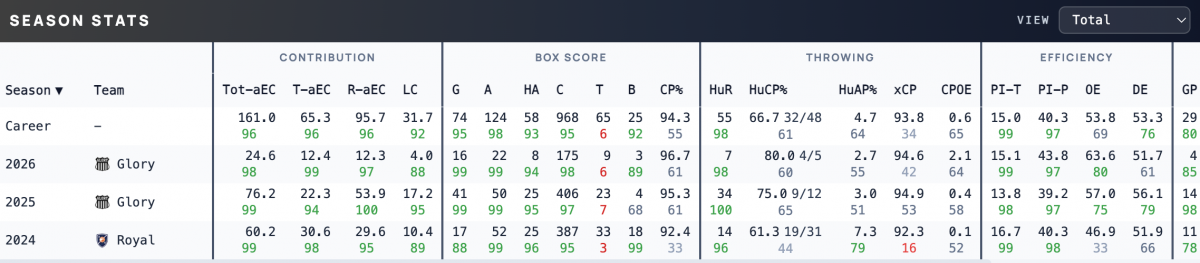
Then came the move to Boston and a different offensive ecosystem. Surrounded by a deeper and more specialized cast, Decraene’s 2025 profile tilted heavily toward receiving. He finished with 54 Receiver aEC compared to 22 Thrower aEC, a split that matched how the Glory used him as a downfield weapon. He created value by constantly winning space, extending advantages, and turning ordinary offensive movement into pressure.
This year, we are seeing a return toward that Montreal balance, only with a much stronger structure around him. Boston has multiple elite players who can share the burden, which allows Decraene to take on more of the offense without playing with the same level of risk he carried as a rookie. Through four games, he has 12.4 Thrower aEC and 12.3 Receiver aEC. One of the league’s best downfield value creators is now helping quarterback one of the league’s best offenses.
The usage numbers make that shift hard to miss. Decraene is averaging 43.8 completions per game, and his offensive involvement rate is over 83 percent. If he keeps up that pace, it would sit next to seasons like 2025 Austin Taylor at 44.2 and 2023 Elijah Long at 44.1, which is pretty wild for someone who still starts possessions downfield and carries the gravity of an elite cutter, receiver, and goal scorer. He is constantly connected to Boston’s offense, even when he is not beginning possessions in the traditional handler spaces.
The connections help explain how the role has changed. Last year, Decraene’s top passer was Simon Carapella and his top target was Calvin Stoughton. Both are cutters, which fits the 2025 version of Tobe. He was operating inside a downfield ecosystem, catching from movement players, throwing to movement players, and doing enormous damage as part of Boston’s continuation game.
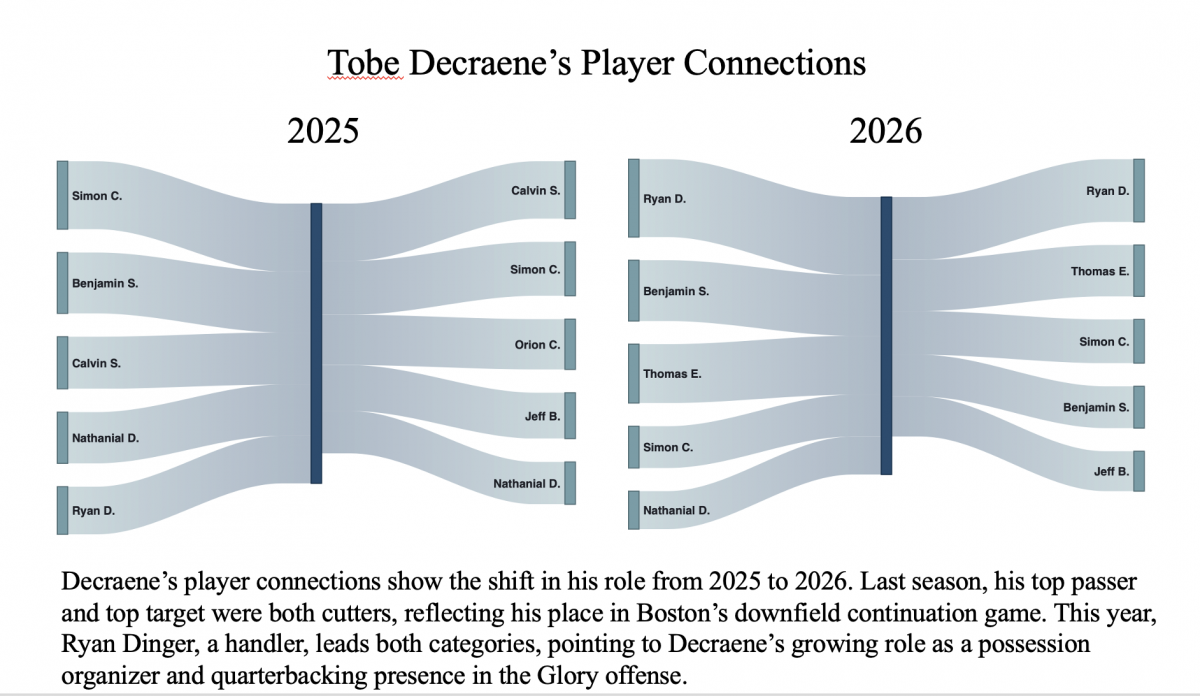
This year, Ryan Dinger has moved into both spots as Decraene’s top passer and top target. Dinger is a handler, and that matters. The central connection in Decraene’s profile has shifted from cutter-to-cutter flow toward handler-to-handler control. Tobe is still a downfield threat, but more of his work now comes from organizing the possession itself. He is receiving from the backfield, giving the disc back to the backfield, reading defenses, and keeping the offense on schedule.
His throwing profile gives that role change more weight. Decraene’s xCP is slightly below average, so these are not just easy touches inflating the completion total. His CPOE is +2.1, a clear jump from his previous seasons at +0.1 and +0.4. CPOE measures whether a player is completing more throws than expected given the difficulty of those attempts, and Decraene is beating expectation while handling more of Boston’s offense than he did last year.
Part of that improvement likely comes from a more selective deep-throwing diet. Compared to his rookie season in Montreal, Decraene is hucking far less often. In 2024, his huck attempt rate was more than twice as high as it is now, 7.3 percent compared to 2.7 percent. That version of Tobe carried a more aggressive throwing profile. The current one is more controlled without becoming conservative. He is 4-for-5 on hucks this season while also being on the receiving end of seven. That combination is what makes him so difficult to solve. He can punish defenses as the thrower or the receiver, and he does not need to force either version of himself into the game.
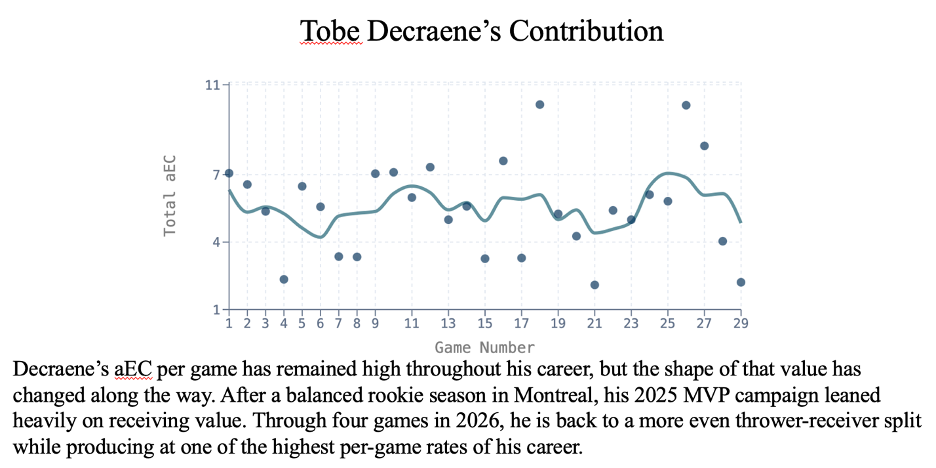
His Week 1 performance against DC is the cleanest example of what this version can look like when everything is clicking. Decraene posted a career-high 5.7 Thrower aEC, the fifth-best single-game mark of the season so far, while still producing like a star across the box score. It was a big Tobe game, but in a slightly different way than we became used to last season. The throwing value led the way, which is a meaningful shift for a player whose 2025 MVP case was so tied to receiving dominance.
The early season has not been perfectly smooth. The Philadelphia game included a career-low Receiver aEC and four turnovers, and his efficiency has not looked quite as sharp over the last two games as it did over the first two. The larger profile has still held up. His contribution efficiency is sitting around 6 aEC per game and roughly 24 per 100 possessions. Among players with at least 15 possessions per game, that puts him behind only Jordan Kerr and Walker Frankenberg in per-game contribution. The volatility is real, but Decraene is still producing elite value while carrying an enormous share of Boston’s offense.
Those numbers make this version of Tobe more interesting than a simple “best player stays great” story. In 2025, Boston had one of the league’s best receiving-value players, and he capped that season with an MVP. In 2026, he is starting to look like something broader. His throwing value has caught up to his receiving value, and his role has expanded from attacking space to managing it. That versatility is the pick-your-poison problem. Treat him like a receiver, and Boston can run offense through him. Force him underneath, and he keeps possessions moving while outperforming as a thrower. Overcommit to the quarterbacking version, and he still has the athleticism, timing, and receiving value that made him an MVP in the first place.